DEF-01
Merchant branding rendered incorrectly
Returned toUI
Case study
Agent orchestration
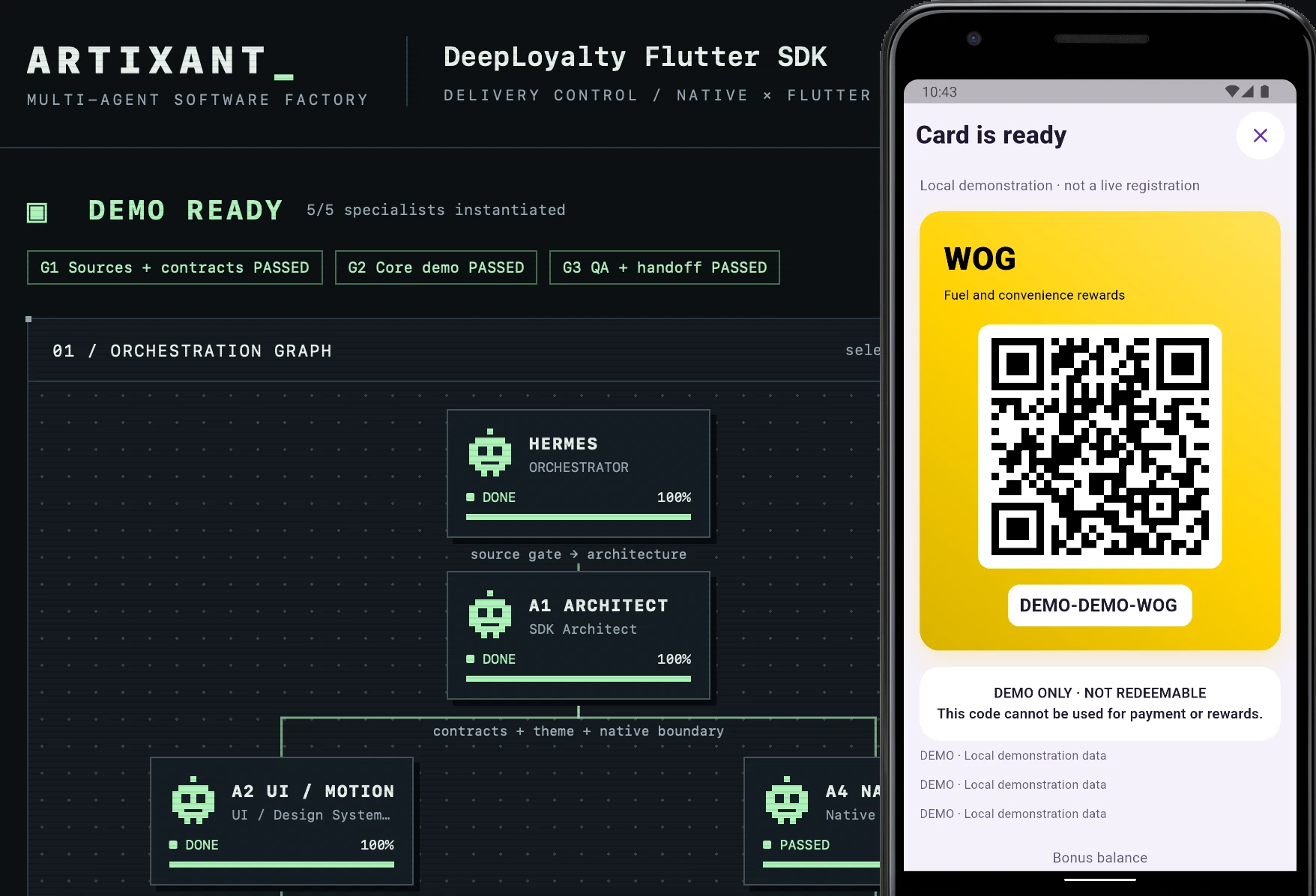
ARTiXANT ran an orchestrated squad of specialist AI agents to turn a European loyalty platform's designs and requirements into a working mobile SDK — architected, built, integrated into native host apps, and independently tested.
05
The squad worked as a software delivery team rather than as a single general-purpose assistant. Every part of delivery had one owner.
02
The orchestrator controlled task ownership, dependencies and handoffs. QA reported to the orchestrator, never to the agent whose work it was judging.
03
When QA found problems, the orchestrator routed each one back to the agent that owned it and triggered a new test cycle. Three of the defects it caught:
DEF-01
Merchant branding rendered incorrectly
DEF-02
QR code left exposed while the app was backgrounded
DEF-03
Lifecycle failures in the iOS host app
Reported · routed · fixed · re-tested
07
The squad delivered:
Why it matters
03
01
Agents work in parallel, but still follow dependencies and exchange structured handoffs.
02
Independent QA judges the output, so no agent signs off on its own work.
03
The trail stays legible — which agent owned what, what came back, and what was re-tested.
ARTiXANT combines this delivery model with human review to build and validate software faster, without hiding unresolved risk.
02
Next
Let's turn it into an agent